Miami | Coral Gables | Miami Beach | Hialeah | Kendall
Foundation repair in Miami
Tell us what you are seeing at the property and the local foundation contractor calls you back with a free quote. Call or send the form to start.
What working with us looks like
One Miami Contractor
Your property goes to a single Miami-Dade foundation contractor, who calls you back.
Free Quotes in Writing
The scope, the method, and the price on paper before anything is signed. The price quoted is the price paid.
Miami-Specific Answers
Limestone, fill, salt air, and the water table are what drive structural work here. Our guides cover all of it.
No Sales Pressure
Plenty of cracks turn out to be cosmetic. If that is the answer, that is the answer.
Scopes of Work
Structural repair scopes for Miami-Dade properties
Underpinning, slab lifting, concrete restoration, seawalls, crack repair, and the structural work that follows an engineer's report on an older building. Costs and methods for each are written out in full.
Foundation Settlement Repair
Underpinning for a footing that has dropped, using helical piers, push piers, or grouting
Read the detailConcrete Slab Leveling and Void Filling
Polyurethane foam or grout injected under a slab that has dropped or gone hollow
Read the detailConcrete Spalling and Structural Restoration
Rebar corrosion repair for slabs, columns, beams, and balconies in salt-air Miami
Read the detailSeawall and Shoreline Stabilization
Cap repair, panel replacement, tieback and grouting work on waterfront Miami properties
Read the detailFoundation and Block Wall Crack Repair
Epoxy and polyurethane injection for cracked stem walls, slabs, and CBS block
Read the detailStructural Restoration for Older Buildings
Repair work carried out against an engineer's report and repair schedule
Read the detailHow It Works
From first call to a written number
Four steps. Nothing costs anything until you sign something.
- 01
Describe what you are seeing
Call or send the form with the property location, the age of the building, and what changed. Photos of a crack with something for scale next to it help more than anything else you can send.
- 02
One contractor calls you back
We connect the property with the Miami-Dade foundation contractor, who calls to talk through the symptoms and set a time to look at it.
- 03
Assessment and free quote
The visit covers elevations, crack widths, drainage, and history. What follows is a written quote covering the method, the quantities behind it, engineering if the scope needs it, and what gets put back afterward.
- 04
Read up before you decide
Our guides cover Miami costs, underpinning methods, spalling, seawalls, and what the ground here does. Take the time you need with the number in front of you.
Miami Is Not A Clay Market
Almost everything written about foundations assumes the wrong ground
Search for foundation advice and you will read about expansive clay that swells in the wet season and shrinks in drought, about hydrostatic pressure against basement walls, about frost heave. None of it applies in Miami-Dade. The USDA soil survey records a maximum shrink-swell potential of 5.2 percent anywhere in this county and a county-wide average under 0.2 percent, with no Vertisols mapped at all. There are effectively no basements, and it does not freeze.
What moves buildings here is different. Limestone at variable depth with soft pockets in it, imported fill that was never compacted properly, organic soil under neighborhoods built over former wetland, and water moving through some of the most permeable ground in the country. Diagnose a Miami house with a Dallas playbook and you will reach the wrong answer confidently.
Across Miami-Dade
The county's ground changes street by street
Miami-Dade holds 34 incorporated municipalities across roughly twenty feet of total vertical range, and where a property sits within that range shapes what is likely to be wrong with it. These are the patterns that repeat.
On the Miami Rock Ridge
The higher limestone ground running from North Miami Beach south and west toward Long Pine Key, eight to fifteen feet above sea level and over twenty in places. Rock is often shallow, deep settlement is uncommon, and the work skews toward concrete restoration on older buildings.
West of the ridge
Doral, Kendall, and the western suburbs sit on lower ground raised with fill. The soil survey maps more than 33,000 acres of human-transported material across urban Miami-Dade. Where that fill was not compacted in proper lifts, it keeps consolidating under load for decades.
On the barrier islands
Miami Beach and Key Biscayne carry the most severe salt exposure in the county. Florida's transportation design guidelines class structures within 2,500 feet of high-chloride water as extremely aggressive, and spalling dominates the caseload accordingly.
On canals and bay frontage
Seawalls are the structure that fails first, and they fail by letting soil out rather than by falling over. A dished patch in a waterfront lawn is nearly always material that has left through a joint, not a sinkhole.
In the low south of the county
Palmetto Bay, Cutler Bay, and the ground toward Homestead sit close to sea level with organic soils in the profile. Around sixteen percent of Miami-Dade is mapped as muck or peat, and settlement over it is slow and long-running rather than sudden.
In older multifamily buildings
Work here usually starts with an engineer's report and the repair schedule attached to it rather than with a symptom somebody noticed. On a building of any age, that schedule is normally dominated by concrete restoration.
Coverage runs across the county, including the smaller municipalities and the unincorporated areas. See the service area pages.
Measure First
A quote written before anything was measured is a guess with a price on it
Structural pricing follows quantities. On a piering job the number of piers and the depth to competent bearing set the cost, and those come out of an engineer's analysis of what is under the building, not out of a walk around it. That is why a proper assessment starts with an elevation survey, dated crack readings, and where the scope warrants it a boring log or a test pit.
It is also why a fair number of these conversations end without a repair. Plenty of the cracks people find turn out to be shrinkage or thermal movement in the stucco, and a wall that has not moved in three months of readings does not need piers. That is a good outcome, and saying so is part of the job.
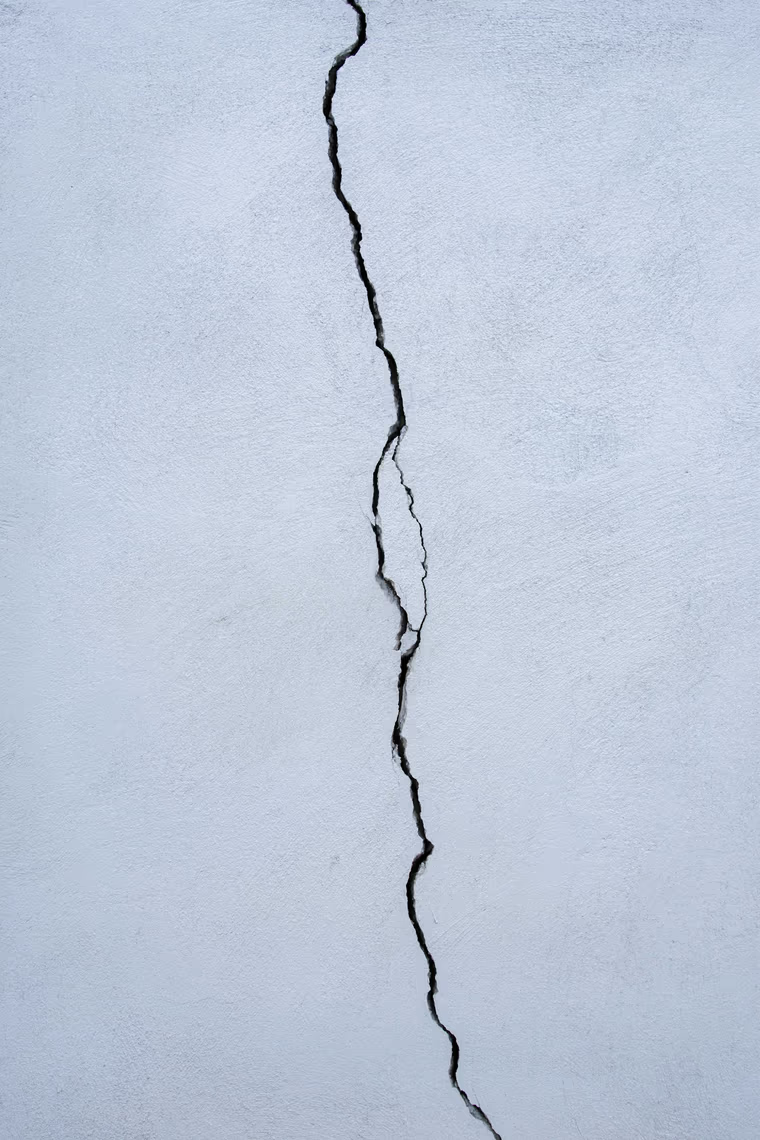
What a written quote should set out
- The method, and why that method rather than another
- Quantities: pier count, spacing, depth or torque criterion, or square feet of concrete removal
- What those quantities are based on: the survey, the boring log, the sounding
- A unit rate for quantities beyond the estimate, so an overrun is arithmetic
- Who carries the engineering, and whether its cost is inside the number or outside it
- What gets put back afterward: concrete, pavers, stucco, planting
- A payment schedule tied to milestones rather than to dates
The Miami cost guide covers what each of those lines usually comes to, and the cost estimator will size a job in about fifteen seconds.
Common questions
What does foundation repair cost in Miami?
Why would a house in Miami settle if there is limestone underneath?
Which cracks in a block wall matter?
Do I need an engineer?
Are sinkholes a risk here?
How do I get a quote?
Get a free quote on foundation work in Miami
Call (786) 841-1091 or send the quote form. Tell us the property location and what you are seeing at the house, and the rest is a conversation.