Cornerstone Guide
Foundation repair in Miami: what goes wrong here
Almost everything written about foundation repair assumes expansive clay and a basement. Miami-Dade has neither. This guide covers what really moves buildings in this county, how to tell a live problem from a dormant one, which repairs apply, and what they cost.
If you search for foundation repair advice and read the first ten results, you will learn about expansive clay soils that swell in the wet season and shrink in drought, about hydrostatic pressure against basement walls, and about frost heave. None of that applies in Miami-Dade. There is no meaningful expansive clay here, there are essentially no basements, and it does not freeze. Applying that advice to a Miami house produces a wrong diagnosis and, often, an unnecessary quote.
What sits under a Miami house
Most of urban eastern Miami-Dade sits on or near the Miami Rock Ridge, a limestone outcrop that the county describes as extending south and west from North Miami Beach to Long Pine Key in Everglades National Park. The United States Geological Survey puts the ridge at two to ten miles wide and eight to fifteen feet above sea level between Homestead and north Miami, exceeding twenty feet in places. It is the highest ground in the county, which in this county is not saying much.
The rock itself is the Miami Limestone, a Pleistocene oolitic grainstone. Two things about it matter for foundations. First, it is thinner than people assume: USGS mapping puts the formation at about ten feet or less across much of eastern Miami-Dade, exceeding thirty feet only along the coastal ridge. Second, and more important, USGS describes it as riddled with secondary solution holes that are commonly partly or completely filled with lime mud and sand. The top of the rock is not a flat, uniform bearing surface. It has soft pockets in it, and a footing that lands on one behaves differently from the footing twenty feet away that landed on solid rock.
Away from the ridge, and in the areas that were wetland before they were neighborhoods, the profile softens considerably. USDA soil survey data for Miami-Dade maps roughly 107,000 acres of organic soils, muck and peat, about a sixth of the county's area. It also maps more than 33,000 acres of Udorthents, the classification for human-transported material, concentrated across the urbanized parts of the county. In plain terms: large parts of built Miami-Dade sit on imported fill, and how well that fill was placed and compacted is invisible from the surface and decisive over decades.
There is no expansive clay here, and that is worth knowing
This is the single biggest difference between Miami and almost every other foundation repair market in the United States, and it is measurable rather than anecdotal. USDA soil survey data for Miami-Dade County records a maximum linear extensibility, the standard measure of shrink-swell potential, of 5.2 percent anywhere in the county, with a county-wide average under 0.2 percent. No Vertisols are mapped. The dominant soil series, Krome, Biscayne, Perrine, are carbonatic and described in their official series descriptions as nonplastic.
So when a quote for a Miami house explains that the clay under the slab has been shrinking through the dry season and swelling in the wet season, the quote is describing a place that is not this one. Ask what the boring log says instead.
What does move buildings in Miami
- Poorly compacted fill. Fill placed in thin lifts and density-tested behaves. Fill pushed in and levelled keeps consolidating under load for years, and a footing bearing on it goes down with it. This is the leading cause of settlement west of the ridge and in filled areas generally.
- Organic soil below the fill. Where a lot was raised over former wetland, a pocket of muck or peat under the fill will keep compressing long after construction. It produces slow, long-running settlement rather than a sudden event.
- Water washing fines out. A leaking supply line, a broken drain, stormwater channelled against a wall, or tidal cycling through a failed seawall joint all move fine material out of the ground, leaving voids. The Biscayne Aquifer beneath the county is shallow and extremely permeable, so water moves here far more freely than in most of the country.
- Local disturbance. A pool excavated close to a footing, a utility trench backfilled loosely, a large tree removed and its root mass left to decompose. These produce contained, single-corner movement rather than whole-house problems.
- Discontinuity between old and new. An addition founded at a different depth, or on different material, from the house it was joined to. The crack appears at the join, and the repair is usually limited to one side of it.
What the symptoms mean
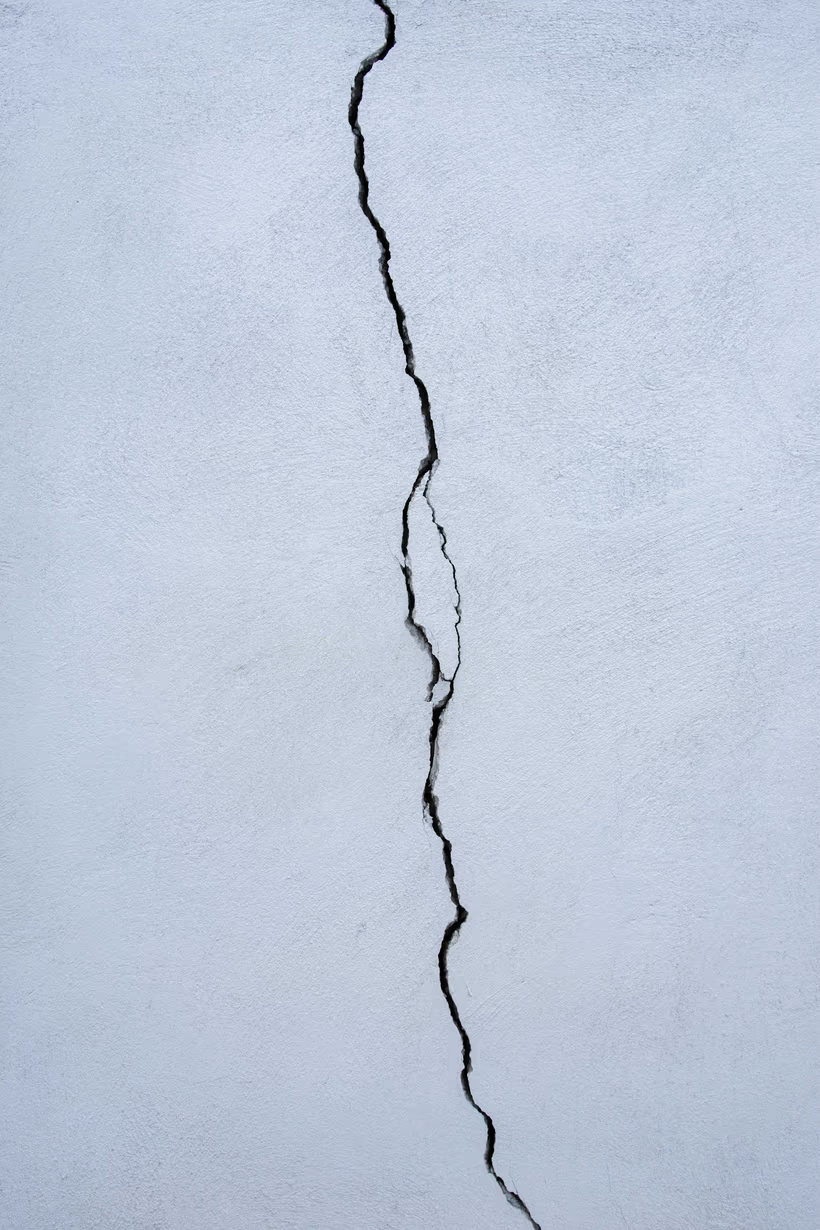
Concrete block walls are stiff. When the ground under one part of a building moves relative to another, the wall cannot bend, so it breaks along the weakest path available, which in block construction is the mortar joints. That is why the classic settlement signature in a Miami house is a stair-step crack running diagonally through a block wall, stepping across and up, usually starting near a corner or above an opening.
Other signals worth logging: doors and windows that have stopped latching; a floor that reads out of level on a laser; tile cracking in a straight line across a room; a gap opening where a slab meets a stem wall; a driveway or patio panel that has dropped at a joint. Any one of these on its own proves nothing. Several of them lining up along one elevation of the house is a pattern.
The full treatment of which cracks matter is in the guide to reading cracks in a concrete block house, including how to measure movement yourself over a few months before spending money on anything.
How a proper assessment runs
- Elevation survey. Floor elevations shot on a grid across the house, producing a contour map of how the floor sits. This converts an impression into a measured amount and a location.
- Crack documentation. Widths recorded with dates, ideally with gauges left in place for 30 to 90 days so movement can be read directly rather than inferred.
- History and site walk. When the building went up, what has been added, where the water goes, whether there is a pool, a canal, a seawall, or recent work in the street.
- Subsurface investigation where the scope warrants it. A boring log or a test pit tells you what a footing is bearing on and how far down competent material sits. On a piering job this is not optional, because the depth and the pier count are the price.
- Engineering. Structural repair drawings in Florida are prepared and sealed by a licensed design professional. The engineer decides the method, the pier count, the depths, and the capacities, which between them are the largest cost item on the job, so having them set by someone who does not sell piers is worth the fee on its own.
The repair options, cheapest first
- Crack repair, $500 to $3,000. Epoxy injection to structurally rebond a stable crack, or polyurethane where the issue is water rather than strength. Only appropriate once you know the movement has stopped.
- Slab leveling, $1,400 to $6,500. Polyurethane foam injected through small ports to fill a void and lift a dropped slab. Fast, light, and back in service the same day.
- Spalling repair, priced by quantity. Removing concrete back past corroded reinforcement, cleaning or replacing the steel, and rebuilding the section. The dominant scope on older coastal buildings.
- Underpinning, $9,000 to $35,000. Carrying a settled footing down to competent bearing on helical piers, resistance piers, or micropiles, or densifying a soft zone with grout.
- Seawall work, priced by the linear foot. Grouting and joint sealing at the low end, full replacement at the high end, with barge or crane access adding substantially where equipment cannot reach by land.
Full bands and what moves them are in the Miami cost guide, and the cost estimator will give you a band in about fifteen seconds.
The order a foundation repair happens in
Almost every avoidable problem on this kind of job comes from doing these in the wrong order, usually by quoting before measuring.
- Measure, then wait. The elevation survey and the first crack readings come first, and on anything that might still be moving there is a monitoring period of 30 to 90 days before a repair is designed. A wall that has not moved in three months does not need piers, and finding that out is the cheapest possible outcome.
- Find the water. Where movement traces to a leak, a broken drain, or stormwater against a wall, that gets fixed before anything structural is committed to. Underpinning over an active leak is buying time at full price.
- Establish what is down there. A boring log or a test pit on any scope that involves piers, because the depth to competent bearing and the pier count are the price.
- Design. Method, pier count, spacing, depths, capacities, and the details for how load transfers onto the piers. This is the document everything else is priced against.
- Price against the design. A quote that names quantities can be compared with another quote that names quantities. Two lump sums cannot be compared at all.
- Install, and verify as you go. Torque readings on helicals, refusal on push piers, sounding on concrete removal. Each of these is a number recorded at the time, on work that is invisible by the end of the week.
- Lift, if lifting is realistic, then put it back. Stabilization first, recovery of elevation second where the structure will safely take it, and concrete, pavers, stucco, and planting reinstated at the work areas.
A quote that skips straight to step six, with a pier count and a price and nothing behind either, is describing a job nobody has diagnosed yet.
What this is probably not
Two fears come up constantly and both are usually misplaced. The first is sinkholes. The Florida Geological Survey's statewide sinkhole favorability model places Miami-Dade in its lowest class, and its subsidence incident database holds four records for the county out of roughly 4,400 statewide, none coded as a confirmed sinkhole, against more than 600 for Hillsborough County. The sinkhole guide covers this properly.
The second is the 2021 Surfside collapse, which sits in the back of a lot of Miami-Dade minds. NIST released its technical findings in June 2026 and attributed the collapse to punching shear failure at pool deck slab-to-column connections, driven primarily by deviations of the original design from the codes and standards of its day and by deviations in construction from the design drawings, with long-term corrosion as a contributing degradation mechanism. NIST expressly ruled out foundation failure, sinkholes, and settling. Whatever your building's structural questions are, that is not the precedent for them.
Get a free quote
Call (786) 841-1091 or send the quote form. Describing what you are seeing costs nothing, and so does the written quote that follows.
Questions on this
How do I know whether this is serious?
Does foundation trouble in Miami mean the house is unsafe?
Will my insurance cover it?
How long does the work take?
Sources
- Miami-Dade County on the extent of the Miami Rock Ridge.
- USGS Water-Resources Investigations Report 90-4108 on the ridge dimensions, Miami Limestone thickness, and solution holes.
- USDA NRCS Soil Data Access, Miami-Dade County Area survey, for soil orders, linear extensibility, and Udorthents acreage.
- NIST, technical findings on the 2021 Champlain Towers South collapse, released June 2026.