Diagnosis
Reading cracks in a concrete block house
Most cracks in a Miami house are not a structural problem, and a fair number of the ones that are can be handled cheaply if they are caught while they are still small. Telling them apart is a matter of pattern and measurement, and you can do most of it yourself.
Nearly every house in Miami-Dade is concrete block with stucco over it, and block behaves in a particular way. It is stiff and strong in compression and almost useless in tension, and it is assembled from units bedded in mortar, which means it has a built-in grid of weaker lines running through it. When something moves, the wall does not bend. It breaks, and it breaks along that grid. That is why crack patterns in a block house are readable in a way they are not in a timber-framed one.
The three things that matter
- Width. Not how long the crack is, and not how dramatic it looks against fresh paint. Width.
- Pattern. Where it runs, whether it follows the mortar joints, whether it changes width along its length, whether there is an offset across it.
- Change over time. The one that settles arguments. A quarter-inch crack that has been the same width for fifteen years is a repair job. A hairline that has doubled since spring is a diagnosis job.
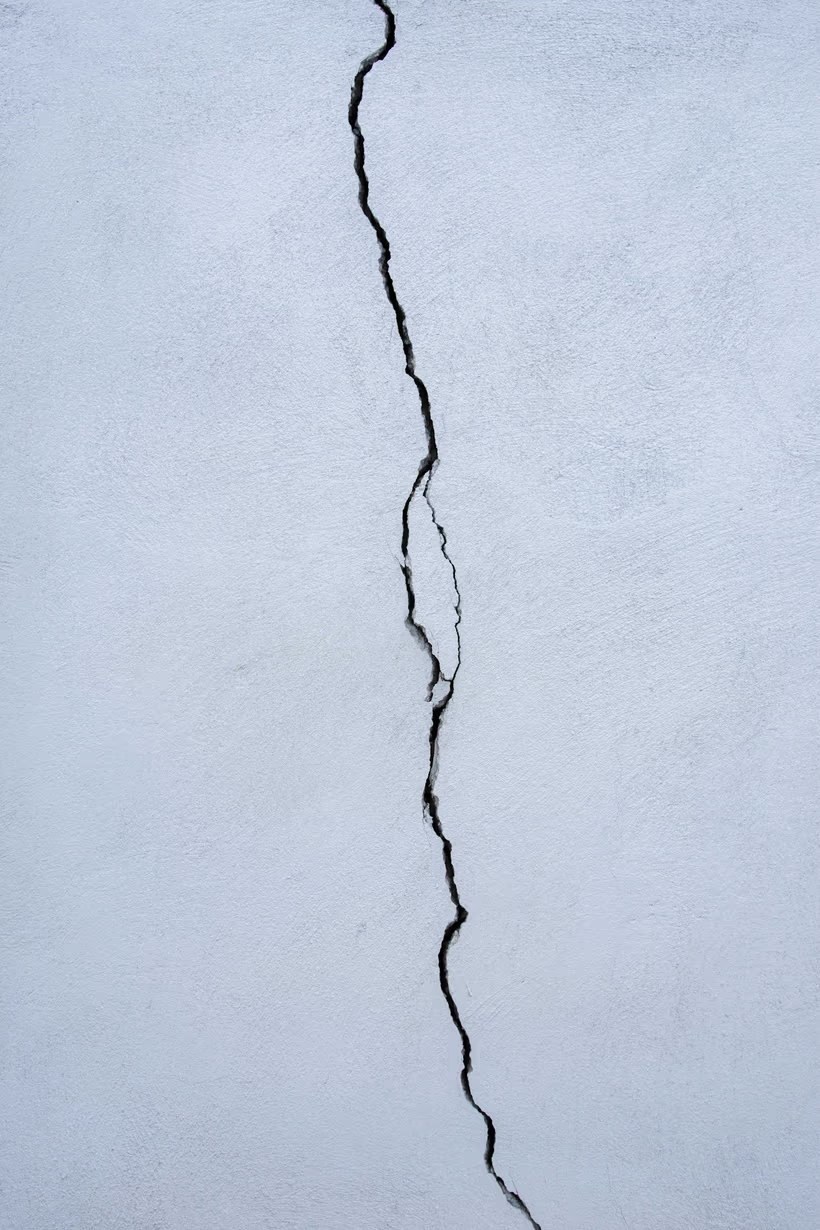
Patterns and what they usually mean
- Fine vertical cracks in stucco, uniform width, no offset. Usually shrinkage in the coating or thermal movement in a long run of wall. Cosmetic. Very common on south and west elevations that take the most sun.
- Stair-step cracks following mortar joints. The signature of differential movement. The wall has broken along its weakest path. Worth taking seriously, though the cause may be below the wall, above it, or beside it.
- Cracks above and running diagonally from the corners of windows and doors. Openings concentrate stress. Short cracks from a corner are common and often benign. Long ones extending well past the opening, especially if they continue below the sill, point at movement.
- A crack that tapers, wider at one end. The two sides have rotated relative to each other. The wide end is the direction of movement. This is a settlement or rotation signature.
- A crack with an offset, where you can feel a step across it. The faces have moved out of plane. Get someone to look at it whatever its width.
- Horizontal cracking along a mortar joint, particularly with the wall bowing. Less common in Miami than in basement markets, but where it appears, it deserves prompt attention rather than monitoring.
- Cracking concentrated where an addition meets the original house. Two structures founded differently, moving independently. Very common in this county and usually a contained repair rather than a whole-house one.
- A rust-colored line inside the crack. Not a settlement crack at all. That is corrosion of embedded steel splitting the concrete from the inside, and it belongs in spalling rather than in this guide.
How to measure it yourself
This costs almost nothing and it is the most useful thing you can do before spending money.
- Mark both ends of the crack with a pencil line across it and write the date beside each mark.
- Photograph it with a coin, a ruler, or a tape measure in frame so scale is recorded. Shoot square to the wall, in the same light, from roughly the same place each time.
- Draw a line across the crack at its widest point and measure the gap. A set of feeler gauges or a printed crack comparator card gives a usable number for a few dollars.
- Repeat monthly for at least three months. Wet season and dry season both matter in Miami, so a reading in September and one in March are more informative than two in a fortnight.
- If you want a direct reading, a crack monitor gauge, two overlapping plates with a graduated scale, screws either side of the crack and shows movement without interpretation.
Three months of readings answers the only question that really matters. If nothing has changed, the movement that caused the crack has finished, and the repair is injection and finishing. If it has changed, the cause is still active and needs identifying before anything is filled.
What to look at besides the crack
Cracks are one symptom among several, and the ones that agree with each other are the ones worth acting on.
- Doors and windows that used to latch and now do not, or that have started to swing open on their own.
- Gaps opening between skirting and floor, or between a slab and a stem wall.
- Tile cracking in a straight line across a floor rather than in one spot.
- A floor that reads out of level. A marble or a golf ball will tell you something; a laser level tells you more.
- Exterior clues: a patio or driveway panel dropped at a joint, a soft or dished area in the lawn, water standing against a wall after rain, a downspout discharging at the base of the house.
If several of those line up along the same elevation, you have a pattern rather than a crack, and an elevation survey is the right next step.
When to stop monitoring and call someone
Monitoring is for slow, ambiguous situations. Some situations are not ambiguous. A crack visibly wider week to week, a wall bulging out of plane, a floor that has dropped enough to see without instruments, or water entering through a structural crack are all reasons to have someone look now rather than in three months. So is any of the above appearing suddenly after nearby excavation, a burst main in the street, or work on a neighboring lot.
Everything else is a measurement problem, and measurement is cheap.
Get a free quote
Call (786) 841-1091 or send the quote form. Describing what you are seeing costs nothing, and so does the written quote that follows.
Questions on this
How wide is too wide?
Do stucco cracks always mean the wall behind is cracked?
The crack keeps coming back after we patch it.
Should I fix cracks before selling?
Related reading
- What Miami houses sit on, for why movement happens here at all.
- Underpinning methods explained, for what happens if the movement turns out to be live.
- Glossary, for the terms used above.