Concrete Restoration
Concrete spalling and rebar corrosion in coastal Miami
The most common structural finding in Miami-Dade is not a settled footing. It is reinforced concrete coming apart from the inside because the steel in it is rusting. Here is the mechanism, why the coast makes it worse, and what a repair that lasts involves.
Reinforced concrete works because two materials cover each other's weaknesses: concrete takes compression, steel takes tension, and the concrete's high alkalinity keeps a passive oxide film on the steel that stops it corroding. Break that chemistry and the partnership fails. In coastal Miami-Dade, the thing that breaks it is salt.
The mechanism
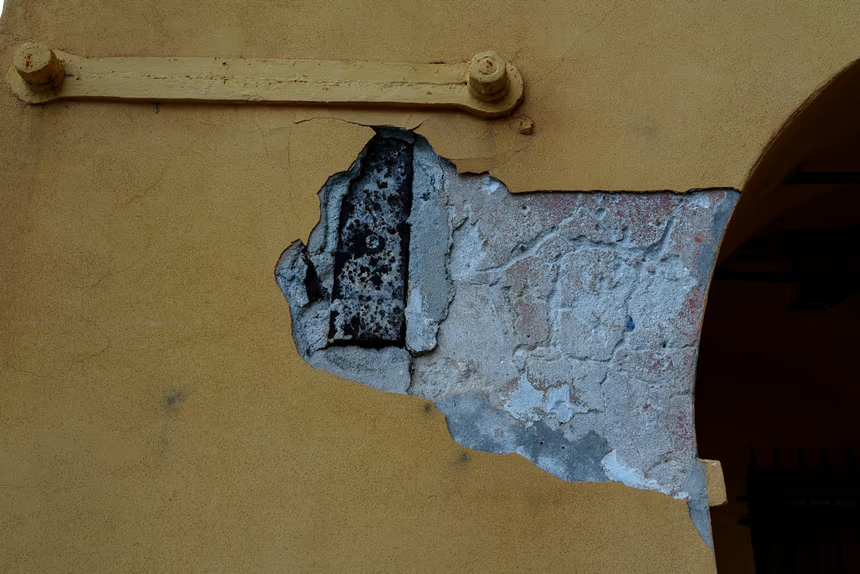
Chloride ions from salt air, salt spray, and salt water migrate into concrete through its pore structure. When enough of them reach the reinforcement, the passive film breaks down locally and corrosion begins wherever moisture and oxygen are present, which near the coast in a subtropical climate is most of the time. Corrosion products occupy several times the volume of the steel they came from. That expansion has nowhere to go, so it splits the concrete cover off from the inside.
The visible sequence runs: a rust stain, then a hairline crack tracking along the line of the bar, then a hollow-sounding area, then a piece of concrete on the ground with corroded steel behind it. Each stage is cheaper to deal with than the next.
Why the coast is worse, with a number attached
This is not a matter of opinion in Florida. The state's own transportation structures design guidelines classify a structure over or within 2,500 feet of water carrying more than 6,000 parts per million chloride as an extremely aggressive environment for both superstructure and substructure. Soil or water with more than 2,000 parts per million chloride, or a resistivity below 1,000 ohm-centimeters, triggers the same classification on its own. Seawater runs at roughly 19,000 parts per million.
In practical terms, essentially every structure within half a mile of Biscayne Bay or the ocean sits in the state's most severe exposure category. That classification drives greater concrete cover, corrosion-resistant reinforcement, and protective sealers on new work. Buildings put up before those requirements existed do not have any of it, which is why age and distance from the water together predict where spalling shows up first.
Where it appears on a Miami building
- Balcony slabs and edges. Thin sections, heavy exposure, and often the least concrete cover in the building.
- Tie beams. The continuous reinforced beam around the top of a block wall. Rust staining running horizontally under a soffit is usually a tie beam.
- Lintels over windows and doors. Short exposed spans with reinforcement close to the underside.
- Columns at ground level. Splash zone, irrigation, standing water.
- Walkways and parking decks. Horizontal surfaces that hold water, often with a failed waterproofing layer above.
- Slab edges at the perimeter. Exposed on three sides and frequently the first place a stain appears.
What correct repair involves
- Sound the whole element. A hammer or a chain drag maps every delaminated area, not just what has visibly failed. Expect the sounded area to be several times larger than the visible one.
- Remove concrete back to sound material and past the corroded steel. Including behind the bar. If the chipping stops at the face of the reinforcement, the back of the bar cannot be cleaned and the corrosion continues out of sight.
- Clean the steel to bare metal, or cut it out and lap in new bar where section loss is significant. How much loss is acceptable is an engineering judgement, not a site one.
- Treat the steel with a corrosion-inhibiting coating, or use a migrating inhibitor in the surrounding concrete, where the exposure warrants it.
- Rebuild with a repair mortar chosen to be compatible with the parent concrete in strength, stiffness, and thermal movement. A repair much stiffer than what surrounds it concentrates stress at its edges.
- Rebuild the waterproofing detail, not just the concrete. On balconies and walkways, water getting in is what started this, and a beautifully patched slab under a failed membrane is a countdown.
- Seal or coat afterward to slow the next chloride cycle into the sound concrete around the repair.
Why patching does not work
Two reasons, one obvious and one not. The obvious one: material applied over corroding steel does not stop the corrosion, so the same bar keeps expanding and the patch comes off, usually within a couple of years.
The less obvious one is the incipient anode effect. Fresh, highly alkaline repair material restores passivity to the steel inside the patch. The steel just outside the patch is still surrounded by chloride-contaminated concrete and stays active. That difference in condition along a single continuous bar sets up a corrosion cell, and the result is new spalling appearing in a ring immediately around a repair that was itself done carefully. It is a well-known phenomenon in concrete repair, and it is why the extent of removal, not the quality of the mortar, is the thing that determines whether a repair lasts.
On a larger building, this arrives as a document
For condominium and cooperative buildings, spalling is usually found by an engineer assessing the structure rather than by an owner noticing a stain. What lands with the board is a report and a repair schedule listing quantities and locations, and that schedule is what the work is priced and built against. How that runs, from schedule to close-out, is covered in the guide to structural repairs after an engineer's report, and the repair scope itself in spalling and structural restoration.
Get a free quote
Call (786) 841-1091 or send the quote form. Describing what you are seeing costs nothing, and so does the written quote that follows.
Questions on this
How fast does spalling progress?
Is a sealer or a coating worth applying?
The engineer's report lists a square footage. Will that be the final number?
Does this mean my building is unsafe?
Sources
- Florida Department of Transportation Structures Design Guidelines, section 1.3.2 and Table 1.3.2-1, on Extremely Aggressive environmental classification.
- USGS Scientific Investigations Map 3541 (2025), on the extent of saltwater intrusion at the base of the Biscayne aquifer in Miami-Dade.